
Jeffersontown Directory Collections
Jeffersontown city directory research begins with a regional collection. Louisville Metro Archives reports city and suburban directories from 1832 through 2000, except Civil War years. Its inventory names specific publishers and volumes, but it does not prove that every issue includes Jeffersontown. Check the scope of the exact volume before treating a missing name as evidence.
| Directory source | Dated coverage | Research desk | Way to use it |
|---|---|---|---|
| Otis | 1832 | Metro Archives | Early regional names |
| Collins | 1836, 1838 to 1839 | Metro Archives | Name and address clues |
| Haldeman and Jegli | 1844 to 1846 | Metro Archives | Household and trade entries |
| Caron's | 1871 onward | Metro Archives | Long address sequences |
| City and suburban shelf | 1832 to 2000 | Metro Archives | Bound volumes and microfilm |
| LFPL history resources | Varies | LFPL | Databases, maps, and staff help |
No official source located an unbroken Jeffersontown-only run. Use the broad Louisville and suburban shelf, verify each issue, and search road-name variants. A gap in the collection is not proof that a family was absent.
Jeffersontown Directory Years
The Metro Archives inventory is the best checklist before a visit. It distinguishes early makers such as Otis, Collins, Haldeman, and Jegli from the later Caron's sequence. The archive also holds naturalization, land, marriage, and will records, plus maps, drawings, microfilm, and bound primary volumes. Those sources help test a city directory entry.
The timeline starts with Otis in 1832, moves through several irregular publishers in the 1830s and 1840s, and reaches Caron's long run from 1871. The broad collection continues through 2000. Civil War years are the stated gap. Exact Jeffersontown inclusion may change by issue, mainly when an address was labeled rural, suburban, or Louisville-area.
Coverage should be checked at the issue level. A publisher's date span tells when a title existed, but it does not say which outlying roads, villages, or suburban districts were indexed that year. Start with the table of contents, geographic notes, and street index. If Jeffersontown is not named, test the known street, rural route, nearby post-office wording, and older community name. Then record the negative search with the exact volume title and year. That practice keeps a missed index entry from becoming a false claim that the resident was not present.
| 1832 | Earliest title in the inventory |
|---|---|
| 1836 to 1846 | Early makers and irregular runs |
| 1871 onward | Caron's long-run sequence |
| 2000 | End of the reported broad span |
Jeffersontown Research at LFPL
LFPL Kentucky History and Genealogy offers more than city directories. Its Louisville Newspaper Obituary Index covers 1918 through 1987. Research tools include Sanborn maps, Kentucky Digital Library material, and licensed genealogy databases. Ancestry Library Edition and the LFPL Kentucky History Research database are available at LFPL locations. Remote help remains available at 502-574-1611 while the Kentucky History Room is temporarily closed during the Main Library renovation.
The current collection page shows the available library route. Review LFPL Kentucky History resources before seeking staff help.
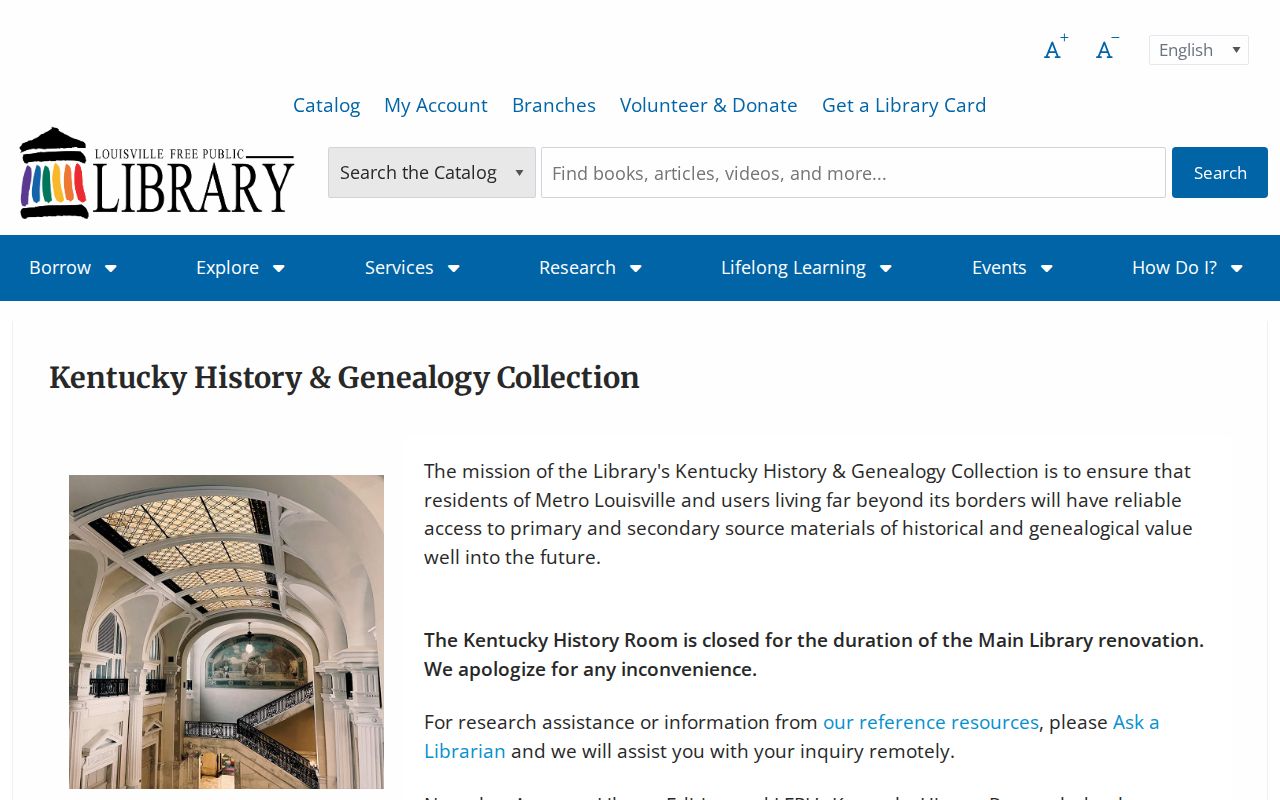
The captured page points researchers toward tools that can connect a directory name with an obituary, map, newspaper, or digitized record. Bring a short list of spellings and years when asking for help. A tight request lets staff check the right directory run, microfilm series, database, or index. Record the collection title and call details supplied by staff, since the same surname may occur in more than one regional source.
Reading Jeffersontown Directory Entries
A city directory entry can compress several facts into one short line. Read the volume's abbreviation key first. A name may be followed by a spouse, trade, employer, and residence address. Some issues distinguish a business address from a home. Later books may add telephone data or a street-order section. Never assume that one publisher's symbol means the same thing in another volume.
| Listed name | The indexed person, sometimes shown with initials |
|---|---|
| Spouse notation | A spouse in parentheses or short form |
| Trade or employer | Dated context, not a permanent fact |
| Street entry | The address as printed that year |
| Cross-reference | A pointer to another name or section |
- Criss-cross directory
- A later directory arranged by street address or phone number.
- Householder index
- An address-order list naming a person linked with a dwelling.
- Abbreviation key
- The publisher's legend for short forms, trades, and marks.
The HABS house-history model in the research shows why each field matters. It pairs Caron's directory occupants with deeds, PVA facts, and Sanborn maps. Its Eddy Street example is in Louisville, so it demonstrates a method rather than a Jeffersontown household claim.
Reverse Jeffersontown Directory Searches
When the goal is a house rather than a surname, look for a street section or reverse volume. Search the exact number and street, then scan nearby numbers because older books may group odd and even sides in distinct ways. Apartment units, rural route descriptions, and changed names can break an exact query. A criss-cross result identifies a listed entry for that issue, not all people who lived there.
Modern parcel and address tools belong in the Jeffersontown street directory. Pairing old and new sources can show whether an address survives, changed form, or now sits within a different parcel description.
Jeffersontown Roads Changed Names
Jeffersontown history says Main and Market streets later became Watterson Trail and Taylorsville Road. The Southern Railroad depot and 1903 electric railway shaped how old sources described the same corridors. Later road widening and suburban growth changed the setting again. Search both old and current names, and keep the source's exact wording in research notes.
Early catalogs may also use Town of Jefferson or Brunerstown. Jeffersontown was formally established as the Town of Jefferson on May 3, 1797, while residents called it Brunerstown. That naming fork is a useful search tactic in city directories, newspapers, manuscripts, and church records. It also guards against the myth that a modern city-name search reaches all historic references.
Road changes also help choose a companion source. Use deeds and plats when a tract was divided. Compare Sanborn maps and aerial images when the built form changed. Search newspapers and directory issues around the Southern Railroad depot, the 1903 electric railway, the Taylorsville Road widening in the 1950s, and the I-64 and Hurstbourne changes of the 1960s. Bluegrass Industrial Park and the planned development of a 700-acre dairy farm in 1972 mark later shifts in how addresses and nearby names may appear. These dates do not prove a household moved. They identify points where the address vocabulary deserves a second check.
Jeffersontown Historical Catalog Leads
The Jefferson County Historical Society catalog can extend a directory find with manuscripts, maps, letters, ledgers, and photographs. Filters include decade, type, geographic level, region or location, and street name. The catalog is not a directory replacement. It gives dated context for a person, place, firm, or road found in a volume.
Search the historical society catalog with the surname, street, and year from the entry.
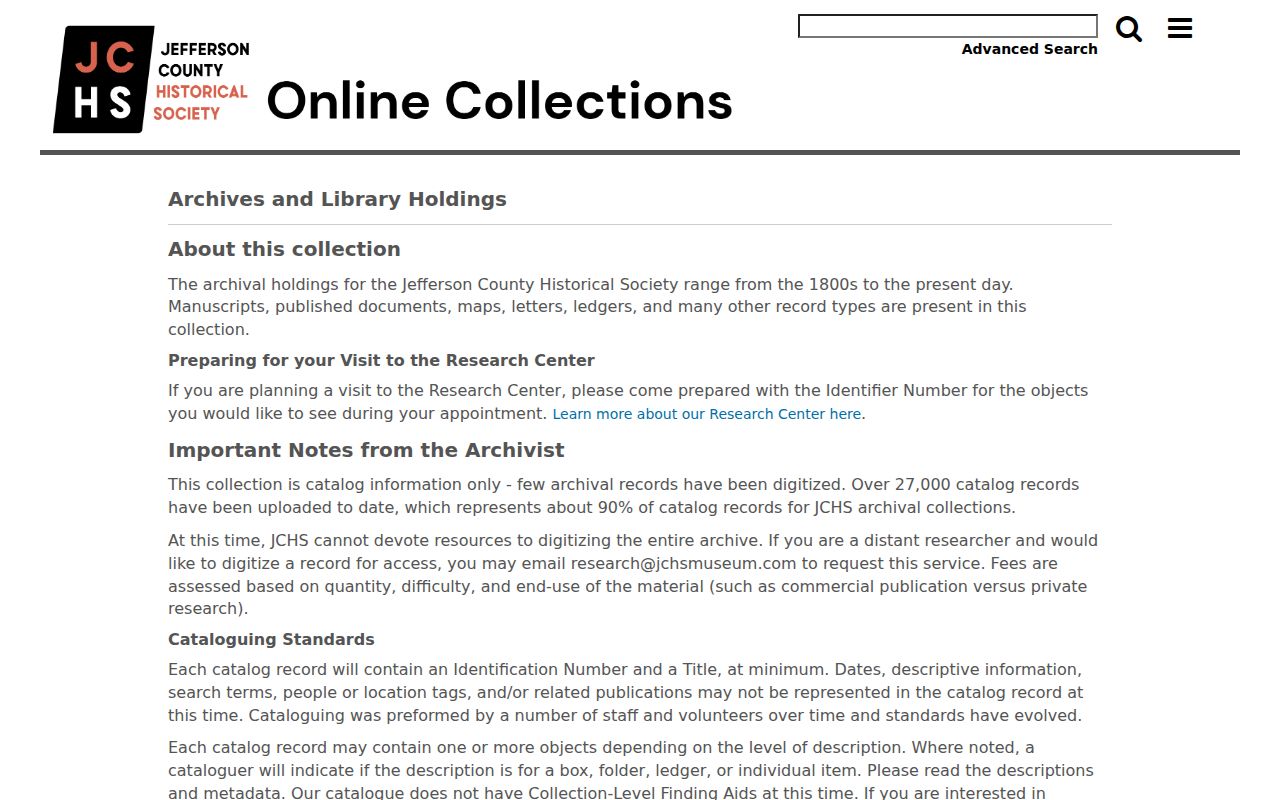
The captured catalog shows a second source path, while the directory remains the dated evidence that began the search.
Trace Jeffersontown Families by Directory
A sequence is stronger than a single hit. Begin near a known event, then move back and forward through available issues. Copy each entry exactly, including initials and marks. Note the first and last appearance at an address. Use census years as fixed comparison points, and close gaps with deeds, obituaries, church sources, maps, or newspapers.
- Choose a known name, street, and rough year.
- Check the closest volume and save a full citation.
- Move through nearby years and note each change.
- Compare the sequence with census and map evidence.
- Test a disappearance with obituary, marriage, or deed records.
A person may vanish because of a move, death, omission, changed name, or a volume's limits. Do not choose one cause without a second record. LFPL's obituary index, Metro Archives maps, and Kentucky genealogy collections can test different possibilities.
The broader genealogy shelf can fill the years between directory hits. FamilySearch lists Kentucky county marriages from 1786 to 1965, probate from 1727 to 1990, historic voter registers, church records, cemetery material, and vital indexes. Access to recent records may be limited, and an index should be checked against the original. The Kentucky Historical Society catalog searches surname, county, title, call number, and material type. KDLA adds archival county and state records. Use those catalogs to find a dated event or relationship, then return to the Jeffersontown directory sequence to see whether the address and household pattern still agree.
Jeffersontown Directory Evidence Limits
A city directory is a dated publication, not proof of current residence. It may list one householder while omitting relatives, boarders, or unlisted people. A business entry may point to a work site. Spelling errors can persist. Even a clear street entry should be labeled with publisher, year, page, and the role stated in the record.
An owner, voter, court party, and obituary subject are distinct roles. Keep them separate. For a modern one-person check, use the workflow on the Jeffersontown resident lookup and confirm each result with its custodian. A directory supports family and place research best when its date and limits stay visible.
Note: Save the title page and abbreviation key with each entry so the citation and symbols can be checked later.